QCQI – Chapter 5 Detailed Summary: Density Operators & Quantum Operations
Learning Objectives
Work with density operators: mixtures, partial trace, Bloch form.
Define and use quantum operations (CPTP maps) with Kraus operators.
Interpret channels via Stinespring dilation and Choi–Jamiołkowski isomorphism.
Compute trace distance and fidelity; understand data-processing monotonicity.
Model common noise (depolarizing, dephasing, amplitude damping) and its Bloch-affine action.
Density Operators
A state is a positive semidefinite operator with unit trace: , . For a qubit,
Purity: .
Eureka! Pure . Noise shrinks inward.
Quantum Operations (CPTP)
A physical operation is linear, completely positive, and trace-preserving (CPTP). Kraus form:
Kraus representations are not unique (related by isometries).
Eureka! “Many realizations, one map”: different sets describe the same channel.
Dilation Pictures
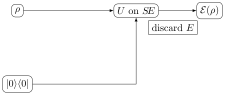
Stinespring. There exists an ancilla , unitary on , and fixed such that
Naimark. Any POVM arises from a projective measurement on a larger Hilbert space.
Eureka! Open dynamics = unitary on a bigger space + discard. Measurements = projective on a bigger space.
Choi–Jamiołkowski (CJ) Isomorphism
Define the (unnormalized) maximally entangled state and the Choi matrix
is CP iff and TP iff .
Eureka! Checking CP reduces to checking positivity of a single matrix: the Choi matrix.
Distances & Fidelity
Trace distance contracts under CPTP:
Uhlmann fidelity is non-decreasing under CPTP:
Eureka! Processing information can only make states harder to tell apart (distance down, fidelity up).
Canonical Qubit Channels (Bloch-Affine Forms)
Depolarizing (prob. ): ; .
Dephasing / Phase-damping (): ; unchanged.
Amplitude damping (): non-unital; roughly , .
Eureka! Unital channels map (Bloch shift ). Amplitude damping is non-unital ().
POVMs
POVM elements satisfy , . Probabilities: .
Realization via Naimark: embed in larger space, apply unitary, measure projectively, and post-process.
Worked Examples
Amplitude damping Kraus set. , .
Choi test. Build ; check PSD and TP by partial trace.
Monotonicity demo. Pick ; compute before/after .
Pseudo-code Aids
Pseudocode — Apply a channel in Kraus form
Input: density matrix , list of Kraus ops Check: (TP) Return:
Pseudocode — Build the Choi matrix
Input: channel via on -dim space Construct and Return
Pseudocode — Stinespring dilation (constructive sketch)
Input: Kraus ops Form isometry ; extend to a unitary on Realize
Schematics
Stinespring Dilation

Choi Test


Hands-on Notebook (Multi-Backend)
Run: L06
In the first cell set backend to one of: cirq, pennylane, braket, pyquil, or qiskit.
Mini-Lab Ideas
Verify TP/unital conditions for given Kraus sets; compute Bloch-affine .
Build for amplitude damping; check PSD and TP by partial trace.
Numerically confirm decreases and increases under (i) dephasing, (ii) amplitude damping.