QCQI – Chapter 3 Detailed Summary: Multiple Qubits, Entanglement & Measurement
Learning Objectives
Build multi-qubit states using tensor products and identify product vs. entangled states.
Compute reduced states via partial trace and reason about local vs. global properties.
Prepare the Bell basis, evaluate correlations, and test the CHSH inequality.
Understand projective measurements on multi-qubit systems and readout correlations.
Tensor Products & Composite Systems
For systems and , the joint space is . A general pure two-qubit state is
Product vs. entangled. is a product state iff the matrix has rank 1 (i.e., ).
Eureka! Entanglement is basis-independent: if (pure two-qubit case), no single-qubit basis change can factor the state.
Reduced States & Partial Trace
For (or mixed), the reduced states are For the Bell state , one finds .
Eureka! “Locally maximally mixed, globally pure” is a hallmark of bipartite entanglement.
Bell Basis & Correlations
The Bell states are They exhibit perfect (anti-)correlations along matching axes.
CHSH Inequality (Sketch)
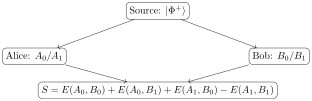
Choose two measurement settings per party: for Alice and for Bob with outcomes . Define correlators . The CHSH quantity is Local hidden variable (LHV) theories obey . Quantum mechanics attains (Tsirelson).
Eureka! Bell violations are operational signatures of nonclassicality; entanglement enables with suitable settings.
Projective Measurements on Two Qubits
A computational-basis measurement applies on . Joint probabilities are ; classical correlations emerge from the joint distribution.
Worked Examples
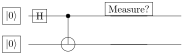
Bell preparation. Apply on qubit and CNOT to to get .
Concurrence (pure two-qubit). . for Bell states; for product states.
Entanglement entropy (pure). ; for Bell states (bits).
Pseudo-code Aids
Pseudocode — Partial trace of a 2-qubit state (trace out )
Input: density matrix (basis ) Output: reduced state Partition into four blocks Return
Pseudocode — CHSH correlator from sampled outcomes
Input: settings implemented by basis-rotations; shots For each shot: sample outcomes ; accumulate Return
Pseudocode — Bell-state preparation (H+CNOT)
Input: start in Apply on qubit ; apply CNOT with control and target Output:
Schematics
Bell Preparation

CHSH Layout (conceptual)

Hands-on Notebook (Multi-Backend)
Run: L03
In the first cell set backend to one of: cirq, pennylane, braket, pyquil, or qiskit.
Mini-Lab Ideas
Prepare each Bell state and measure to verify maximal mixedness.
Estimate CHSH for several angle pairs; approach for optimal settings.
Add depolarizing noise and observe degradation of and entanglement entropy.