QCQI – Chapter 2 Detailed Summary: Qubits, States & the Bloch Sphere
Learning Objectives¶
Parametrize a single-qubit pure state and map to the Bloch sphere.
Interpret single-qubit unitaries as rotations; use ZYZ decomposition.
Measure along X,Y,Z (basis change) and estimate expectation values.
Perform linear-inversion tomography: ρ=21(I+r⋅σ).
States and Bloch Vectors¶
∣ψ(θ,ϕ)⟩=cos2θ∣0⟩+eiϕsin2θ∣1⟩,
r=(sinθcosϕ,sinθsinϕ,cosθ), and
ρ=21(I+r⋅σ).
Eureka! Pure states lie on the Bloch surface (∥r∥=1); noise shrinks ∥r∥<1.
Unitaries as Rotations¶
U=Rz(α)Ry(β)Rz(γ), with Rn(ϑ)=e−i(ϑ/2)n⋅σ.
Eureka! SU(2) double-covers SO(3): global phases vanish at the density level.
Measurements via Basis Change¶
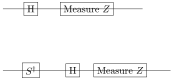
⟨σx⟩=⟨Z⟩ after H;
⟨σy⟩=⟨Z⟩ after S†H;
⟨σz⟩=⟨Z⟩ directly.
Tomography¶
Estimate ⟨X⟩,⟨Y⟩,⟨Z⟩ from repeated shots, then set
ρ^=21(I+m^xX+m^yY+m^zZ).
Purity: Tr(ρ2)=21+∥r∥2.
Worked Examples¶
State preparation. Apply Ry(θ) then Rz(ϕ) to ∣0⟩.
Expectations from counts. ⟨Z⟩=(N0−N1)/(N0+N1); for X(Y) prepend H(S†H).
Global vs relative phase. eiγ∣ψ⟩ unchanged; relative phases impact interference after basis rotations.
Pseudocode — Prepare ∣ψ(θ,ϕ)⟩ from ∣0⟩
Input: angles (θ,ϕ)
Steps: apply Ry(θ); then Rz(ϕ)
Output: state ∣ψ(θ,ϕ)⟩
Pseudocode — Measure ⟨σk⟩
Input: axis k∈{x,y,z}, shots S
if k=x: prepend H; if k=y: prepend S† then H
measure Z for S shots; return (N0−N1)/(N0+N1)
Pseudocode — Single-qubit tomography (linear inversion)
Input: unknown state, shots per basis S
estimate m^x,m^y,m^z as above
set ρ^=21(I+m^xX+m^yY+m^zZ)
Bloch Sphere (axes only)¶