QCQI – Chapter 1 Detailed Summary: Overview & Postulates
Learning Objectives
State and apply the postulates of quantum mechanics (finite-dimensional setting).
Use Dirac notation fluently; convert to matrix form when needed.
Compute measurement probabilities (projective/POVM) and post-measurement states.
Compose systems via tensor products; form reduced states by partial trace.
Big Picture
Quantum algorithms engineer interference so that “wrong” amplitudes cancel and “right” amplitudes add.
Eureka! A quantum algorithm is a designed interference pattern: unitaries steer phases; measurement reads out the amplified answer.
Dirac Notation & Bloch Refresher
, . Up to global phase, .
Eureka! One qubit needs two angles: the Bloch sphere parameters .
Postulates
State. Pure: ; Mixed: .
Evolution. Closed: unitary. Open: CPTP map .
Measurement. Projectors with and collapse. General POVM: effects , .
Composition. , reduced states by partial trace.
Eureka! Pure global entanglement can look locally maximally mixed: for , .
Worked Examples
Projective Z-measurement. For : , .
POVM via Kraus. Effects give .
Partial trace. For , .
Pseudo-code Aids
Pseudocode — Projective measurement (one qubit)
Input: Output: and post-measurement state Draw if : return , state else: return , state
Pseudocode — Apply a quantum channel (Kraus form)
Input: , Kraus set with Output:
Schematics


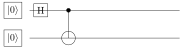
Bell-Pair Preparation (H + CNOT)

Hands-on Notebook (Multi-Backend)
Run: L01
Set backend to cirq, pennylane, braket, pyquil, or qiskit.