QCQI – Chapter 11 Detailed Summary: Quantum Shannon Theory & Channel Capacities
Course Notes (MSU)
Learning Objectives
Understand Schumacher compression and the role of von Neumann entropy as the quantum source coding rate.
Use the Holevo information and the HSW theorem for classical capacity of quantum channels.
Define coherent information and state the Lloyd–Shor–Devetak (LSD) theorem for quantum capacity.
Explain entanglement-assisted communication and compute .
Work hands-on with qubit channels (depolarizing, amplitude damping): simulate, estimate entropies/capacities numerically.
Quantum Source Coding (Schumacher)
An i.i.d. source emits pure states with average density . For signals, the typical subspace has dimension and captures almost all probability.
Theorem (Schumacher). For any and large , there exist an isometry (encoder) and a decoder such that and the average fidelity is at least .
Eureka! Entropy is the qubit compression rate: qubits per signal, just like Shannon’s bits.
Classical Communication over Quantum Channels
A quantum channel is CPTP. To send classical messages , choose codewords (quantum states) and a POVM at the receiver.
Holevo Information & HSW
For ensemble and outputs ,
HSW theorem: The product-state classical capacity is The (regularized) classical capacity ; additivity need not hold in general.
Eureka! Accessible information is upper-bounded by Holevo ; optimal codes approach it (HSW).
Quantum Capacity & Coherent Information
Coherent information for input state is where purifies . LSD theorem: The quantum capacity . For degradable channels, the limit is single-letter.
Eureka! Coherent information plays Shannon’s role for quantum data: it is the rate of reliably transmitted qubits.
Entanglement-Assisted Capacities
With unlimited prior EPR pairs, the entanglement-assisted classical capacity is the quantum mutual information of the channel’s Choi state constructed from the purification . This is single-letter and additive.
Eureka! Shared entanglement upgrades a noisy quantum channel to a clean classical pipe of size mutual information.
Canonical Qubit Channels
Depolarizing:
. Symmetric and unital; is maximized by .
Amplitude Damping:
with Kraus , . Degradable for (single-letter ), anti-degradable for large ().
Pseudo-code Aids
Pseudo-code: Schumacher compression (typical-subspace sketch)
Input: source average , blocklength , thresholds Compute eigenpairs of Define projector onto sequences with empirical entropy Encoder: isometry with Decoder: inverse isometry on typical subspace; declare failure otherwise
Pseudo-code: Holevo for an ensemble through a channel
Input: , channel Compute Return
Pseudo-code: Coherent information (one-letter lower bound)
Input: state , channel Let be a purification of Compute Return
Pseudo-code: Entanglement-assisted capacity
Input: channel Optimize over : of
Schematics
Schumacher Compression


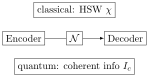
Channel Capacities (concept)

Hands-on Notebook (Multi-Backend)
Run: L15
In the first cell set backend to one of: cirq, pennylane, braket, pyquil, or qiskit.
Mini-Lab Ideas
Simulate depolarizing/amplitude-damping channels; compute for simple ensembles and plot vs. noise.
Numerically maximize for on qubit depolarizing; compare with maximally mixed input.
Estimate a one-letter lower bound on by maximizing over single-qubit states.
Emulate Schumacher compression on small with a typical-subspace projector; measure average fidelity.