QCQI – Chapter 10 Detailed Summary: Entanglement, Entropy & Information Tasks
Course Notes (MSU)
Learning Objectives
Use von Neumann entropy , mutual information , and conditional entropy .
State and apply key inequalities: subadditivity, Araki–Lieb, and strong subadditivity (SSA).
Characterize and manipulate entanglement under LOCC: Schmidt form, majorization, concentration/dilution, distillation.
Compute mixed-state entanglement measures in small systems: concurrence, entanglement of formation, negativity.
Implement and analyze canonical information tasks: teleportation, dense coding, and entanglement swapping.
Entropy and Information
von Neumann entropy ; for pure bipartite with Schmidt coefficients , the entanglement entropy is .
Mutual information quantifies total correlations. Conditional entropy may be negative in quantum theory (signature of entanglement).
Relative entropy is nonnegative and monotone under CPTP maps (data-processing).
Eureka! Negative (impossible classically) flags that can be predicted from better than classically—entanglement supplies the “missing bits.”
Key inequalities
SSA conditional mutual information .
Eureka! SSA is the “triangle inequality” of quantum information: correlations cannot increase when discarding systems.
Schmidt Decomposition & Majorization
Any pure bipartite state has . Under LOCC, is possible iff is majorized by (Nielsen’s theorem).
Eureka! LOCC cannot sharpen the Schmidt spectrum. Conversions are governed by a single preorder: majorization.
Entanglement Manipulation
Concentration (pure states)
From many copies of a partially entangled state, LOCC can produce nearly Bell pairs (typical subspace argument).
Dilution
Conversely, Bell pairs can be consumed to create copies of a target entangled state at rate .
Distillation (mixed states)
Protocols such as BBPSSW/DEJMPS use bilateral CNOTs and measurement to increase fidelity with a Bell state, keeping pairs on certain outcomes.
Eureka! Pure-state entanglement is fungible: rate equals the entropy of entanglement. Mixed-state entanglement is subtler: distinct notions (distillable entanglement, entanglement cost) need not coincide.
Separability Tests & Mixed-State Measures
PPT criterion: If then is entangled (negativity quantifies this). For and , PPT separable.
Two-qubit concurrence (Wootters): , where are the decreasing square roots of eigenvalues of with . Entanglement of formation with binary entropy.
Eureka! For two qubits, “how entangled?” has a closed form: the concurrence.
Information Tasks
Teleportation
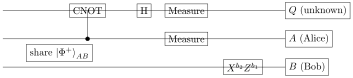
Consume one Bell pair and two classical bits to transfer an unknown qubit using a Bell measurement and Pauli corrections.
Dense Coding
Send two classical bits by transmitting one qubit given a shared Bell pair, via local Pauli encodings and a Bell measurement at the receiver.
Entanglement Swapping
Bell-measure two halves of independent Bell pairs to entangle the distant, previously uncorrelated ends.
Eureka! Entanglement is a resource convertible into communication tasks: qubits cbits when EPR pairs are available.
Pseudo-code Aids
Pseudo-code: Wootters Concurrence (two qubits)
Input: density matrix (sorted decreasing as square roots)
Pseudo-code: Negativity
Input: partial transpose on
Pseudo-code: BBPSSW-like One-Round Distillation (concept)
Given: two noisy pairs Both sides apply CNOT(sourcetarget); measure target in ; keep source iff outcomes agree Optionally twirl Bell-diagonal before repeating
Pseudo-code: Teleportation (Pauli frame)
Share ; sender holds qubit to send Bell-measure and to get bits ; send to Receiver applies on to recover state
Schematics
Teleportation (concept)

Dense Coding (concept)


Hands-on Notebook (Multi-Backend)
Run: L14
In the first cell set backend to one of: cirq, pennylane, braket, pyquil, or qiskit.
Mini-Lab Ideas
Compute , , for Bell, product, and Werner states; verify inequalities numerically.
Implement concurrence and negativity for random two-qubit states; compare vs. ordering.
Simulate one round of BBPSSW on Werner states and plot fidelity improvement vs. parameter .
Build teleportation and dense coding circuits in your favorite framework and verify success by state tomography / counts.