QCQI – Chapter 9 Detailed Summary: Quantum Error Correction, Stabilizers, and Noise
Course Notes (MSU)
Learning Targets
Model noise with Pauli channels and Kraus operators; use the Pauli transfer picture.
State and apply Knill–Laflamme (K–L) error-correction conditions.
Build and analyze stabilizer codes: generators, syndromes, degeneracy, and decoding.
Implement 3-qubit, phase-flip, and Shor 9-qubit ideas; understand CSS/Steane intuition.
Glimpse fault tolerance: transversal gates, cat-state extraction, and the threshold idea.
Noise Models & Error Bases
A single-qubit CPTP map can be expanded in the Pauli basis: for a Pauli channel, or via Kraus operators as .
Eureka! Because form an operator basis, correcting all single-qubit Paulis implies correction of arbitrary small errors (by linearity).
Examples
Depolarizing: . Phase Damping: dephases off-diagonals in -basis. Amplitude Damping: , .
Knill–Laflamme Conditions
A code subspace corrects iff
Intuition: error pairs act like a scalar on the code space—no leakage about the logical basis labels.
Eureka! “All damage syndrome”: the environment learns the error type but not the logical state.
Distance, Detection, and Degeneracy
The distance is the minimum weight of a Pauli that maps one codeword to another (up to stabilizers). A code detects up to errors and corrects up to errors. A degenerate code has distinct errors sharing the same syndrome (coset leaders differ by stabilizers).
Stabilizer Formalism
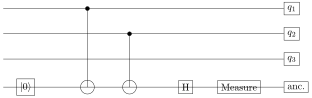
Let be an abelian subgroup with . The code space is the +1 eigenspace of . If then we have an code; measuring the generators gives a syndrome .
Eureka! Commutation simultaneous measurability: we can extract classical bits without collapsing the logical superposition.
Syndrome Extraction (Concept)
Canonical Small Codes
Repetition (bit-flip) 
, , stabilizers , . A single error flips one parity; majority vote recovers the bit.
Phase-Flip via Hadamards
Wrap the above with to protect against errors.
Shor 9-Qubit (Idea)
Concatenate phase-protection within triples and bit-flip protection across triples to correct any single-qubit error.
Eureka! Protect and errors separately in complementary bases; follows since .
CSS and Steane Intuition
Given classical linear codes, CSS builds an code with -checks from and -checks from . The Steane uses Hamming for both parts.
Fault-Tolerance (Glimpse)
Transversal gates prevent a single fault from fanning out. Cat-state ancillas limit hook errors during extraction. Threshold theorem: below a hardware-dependent error rate, scalable computation is possible with polylog overhead.
Pseudo-code Aids
Pseudo-code: 3-qubit bit-flip: encode syndrome correct
Encode: CNOT(); CNOT() Syndrome: measure and via ancillas Decode: map syndrome to on respectively Recover: majority vote or inverse of encode
Pseudo-code: General stabilizer check measurement
Prepare ancilla in (for -type) or (for -type) For each on data: CNOT(dataanc) For each on data: CNOT(ancdata) or basis-change tricks Measure ancilla in ; the bit is the generator eigenvalue
Pseudo-code: Knill–Laflamme numeric test
Compute projector onto code space; for errors compute Verify in the code basis
Hands-on Notebook (Multi-Backend)
Run: L13
Set backend in the first cell to cirq, pennylane, braket, pyquil, or qiskit.
Mini-Labs
Monte Carlo logical error vs. physical error for the 3-qubit code; compare to .
Convert to phase-flip protection and test against -noise.
(Stretch) Sketch a Shor encoder/decoder; correct a single arbitrary Pauli on one qubit using an ideal simulator.