Skip to article frontmatterSkip to article content
Site not loading correctly?

This may be due to an incorrect BASE_URL configuration. See the MyST Documentation for reference.

QCQI - Chapter 8: Grover Search & Amplitude Amplification

Learning Objectives

  • Oracle + diffuser ⇒\Rightarrow rotation in 2D.

  • Optimal iterate count and overshoot.

  • Amplitude amplification and estimation.

Grover Geometry

∣s⟩=sin⁡θ∣β⟩+cos⁡θ∣α⟩|s\rangle=\sin\theta|\beta\rangle+\cos\theta|\alpha\rangle, sin⁡θ=M/N\sin\theta=\sqrt{M/N}.

G=DOfG=DO_f rotates by 2θ2\theta per iterate.

Eureka! Quadratic speedup from planar rotations.

Circuits

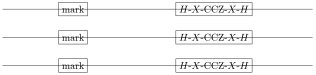
Oracle: conjugated multi-controlled-ZZ; Diffuser: H⊗nX⊗nCCZX⊗nH⊗nH^{\otimes n}X^{\otimes n}\mathrm{CCZ}X^{\otimes n}H^{\otimes n} (for n=3n=3).

Eureka! Reflect about ∣s⟩|s\rangle via Hadamards and a single CCZ.

Amplitude Amplification

Q=−AS0A†SfQ=-A S_0 A^\dagger S_f; same rotation picture.

Amplitude estimation uses QPE on QQ to learn θ\theta.

Schematic: Iterate G=D OfG = D\,O_f (concept)

Hands-on Notebook

Companion notebook (multi-backend): L10_QCQI_Ch08_Grover_and_Amplitude_Amplification

Set backend in the first cell to cirq, pennylane, braket, pyquil, or qiskit.

Mini-Lab

  • Plot PrP_r vs. rr for n=3n=3.

  • Try M=2M=2 solutions and compare with theory.

  • Replace H⊗nH^{\otimes n} by biased AA and check rotation.