Skip to article frontmatterSkip to article content
Site not loading correctly?

This may be due to an incorrect BASE_URL configuration. See the MyST Documentation for reference.

QCQI - Chapter 3: Multiple Qubits, Entanglement & Measurement

Learning Objectives

  • Build and recognize entangled vs. product states.

  • Partial trace, reduced states, and local vs. global properties.

  • Bell states, correlations, and CHSH tests.

Composite States

∣ψ⟩=a∣00⟩+b∣01⟩+c∣10⟩+d∣11⟩|\psi\rangle=a|00\rangle+b|01\rangle+c|10\rangle+d|11\rangle; product if ad−bc=0ad-bc=0.

Eureka! Rank(M)=1(M)=1 ⇔\Leftrightarrow separable (pure two-qubit).

Reduced States

ρA=TrB[ρAB]\rho_A=\text{Tr}_B[\rho_{AB}], ρB=TrA[ρAB]\rho_B=\text{Tr}_A[\rho_{AB}].

For ∣Φ+⟩|\Phi^+\rangle, ρA=I/2\rho_A=I/2.

Eureka! Maximally entangled ⇒\Rightarrow locally maximally mixed.

Bell Basis & CHSH

∣Φ±⟩,∣Ψ±⟩|\Phi^\pm\rangle,|\Psi^\pm\rangle show strong correlations.

S=E(A0,B0)+E(A0,B1)+E(A1,B0)−E(A1,B1)S=E(A_0,B_0)+E(A_0,B_1)+E(A_1,B_0)-E(A_1,B_1).

Classical ∣S∣≤2|S|\le2, quantum up to 222\sqrt2.

Eureka! Entanglement enables ∣S∣>2|S|>2.

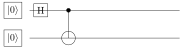
Schematic: Bell Preparation

Hands-on Notebook

Companion notebook (multi-backend): L03_QCQI_Ch03_Multiple_Qubits_Entanglement_and_Measurement

Set backend in the first cell to cirq, pennylane, braket, pyquil, or qiskit.

Mini-Lab

  • Prepare all four Bell states; compute ρA\rho_A and S(ρA)S(\rho_A).

  • Estimate CHSH SS at different angles; compare with 222\sqrt2 bound.